
Are you an Australian Business Owner who is disturbed by the trends in violent crime and wants to ensure their business, staff and family have all the protection they need?



Biometric vs Card Reader vs PIN: The Right Access Control for Your Business
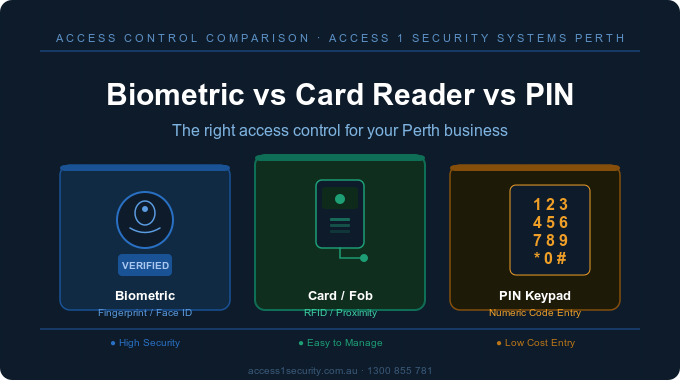
You know your business needs better access control. Maybe you have had a security incident, or your current system is a single padlock and a prayer. Either way, you are now comparing options — and the three most common ones keep coming up: biometric readers, card and fob systems, and PIN keypads.
Each one works. Each one has a legitimate place. But they do not all suit every business, and choosing the wrong system can mean spending more than you need to, or worse, leaving a gap in your security that a determined intruder will find.
This guide breaks down how each system actually works in the real world, who it suits, what it costs to run, and what the security industry in Perth recommends for different types of commercial premises.
If you would rather skip the research and get a direct recommendation for your specific site, call Access 1 Security Systems on 1300 855 781. Our team installs and services access control systems across Perth and WA every day — we will tell you exactly what we would put in your building.
How Each System Works
Biometric Access Control
Biometric systems verify identity using physical characteristics that belong only to the individual — most commonly a fingerprint, but also facial recognition and iris scans in higher-security applications.
When an authorised user presents their finger to the reader, the system checks it against a stored template. If it matches, access is granted. There is nothing to carry, nothing to forget, and nothing to pass to someone else.
Modern biometric readers used in commercial settings do not store actual fingerprint images. They store a mathematical template derived from the fingerprint — making it far more secure than it might sound. Even if the data were somehow accessed, it cannot be reverse-engineered into a usable fingerprint.
Installation typically involves surface-mounted readers at entry points, connected to an electric lock or magnetic lock on the door, and managed through a central control panel or cloud-based software. More advanced setups allow remote management, audit trails, and integration with alarm systems and CCTV.
Card and Fob Access Control
Card and fob readers — also called proximity or RFID readers — are the most widely installed access control technology in Australian commercial buildings. Employees carry a card or key fob programmed with a unique credential. They present it to a reader at the door, and access is either granted or denied.
The system is fast, reliable, and easy to manage. When an employee leaves the business, their card is deactivated in the system — no lock needs to be changed, no key needs to be returned. When a new employee starts, a card is issued and programmed within minutes.
Cards and fobs can be set with time restrictions, too. A cleaner might have access between 6:00pm and 8:00pm on weekdays only. A contractor might have site access for the duration of their job and then have it automatically expire. This is genuinely practical for businesses with shift workers, contractors, or multiple access tiers.
PIN Keypad Access Control
PIN keypads require users to enter a numeric code to gain entry. They are the lowest-cost access control option to install and require no physical credential to carry. The code is the credential.
PIN systems work well in lower-traffic areas, secondary access points, or for businesses with a small, stable team. They are particularly common as a supplementary method — used in combination with a card reader to add a second layer of verification.
The limitation of standalone PIN systems is well known in the security industry: codes get shared. An employee gives their PIN to a visitor, writes it on a sticky note, or tells a colleague who has forgotten theirs. Over time, the integrity of the access control degrades. This is not a theoretical concern — it is one of the most common issues security companies deal with when auditing existing commercial systems.
Security Level Comparison
Let us be direct about this, because it matters for your decision.
System | Spoofing Risk | Lost / Stolen Credential Risk | Audit Trail | Overall Security Level |
Biometric | Very Low | None — credential is physical | Full — individual identity | High |
Card / Fob | Low (with quality readers) | Medium — card can be stolen | Full — per card / fob | Medium-High |
PIN Only | Low | High — code can be shared | Limited — code, not person | Medium |
Card + PIN (Multi-Factor) | Very Low | Low | Full | Very High |
For most Perth businesses, card access strikes a strong balance between security and convenience. Biometrics add the highest level of certainty about who is entering — which matters most in sensitive environments. PIN-only is best reserved for lower-risk access points or where budget is genuinely constrained.
One thing worth noting: a card reader shows which credential was used. A biometric reader shows which person entered. For businesses where individual accountability matters — healthcare, finance, secure storage — that distinction is significant.
Cost and Ongoing Maintenance
Here is where businesses often get surprised. The upfront cost of a system is only part of the picture.
Upfront Installation Cost
Biometric readers carry a higher unit cost than card readers, which in turn cost more than basic PIN keypads. For a single-door installation, the difference might be modest. For a multi-site rollout across 20 or 30 access points, it becomes material.
However, the total installation cost depends on many factors beyond the reader type: the type of lock, the existing door hardware, whether cabling needs to be run, and how the system integrates with your existing security infrastructure. Get a site assessment before assuming any system is out of budget.
Ongoing Running Costs
Card and fob systems have a small ongoing cost in the form of card replacements — lost cards are a reality in any business. Biometric systems have essentially no ongoing credential cost, since the credential is the person. PIN systems cost nothing to run, but the hidden cost is the management overhead when codes need to be changed.
All three system types require periodic software updates and occasional hardware maintenance. A reputable security company will offer a service and maintenance agreement — this is worth having, as access control systems are critical infrastructure and you do not want a failure on a Friday night.
Access 1 Security Systems provides ongoing service and maintenance agreements for all access control installations across Perth and WA. This includes remote monitoring, software updates, and priority call-out if a fault occurs.
Best Fit by Business Type
This is where the decision usually gets clearer. The right system for your business depends heavily on what you are protecting, how many people need access, and how much staff turnover you experience.
Office Environments
Card or fob access is the industry standard for offices, and for good reason. It is fast at entry, easy to manage as staff come and go, and integrates cleanly with building management systems. For executive areas, server rooms, or finance departments, a second layer — either biometric or PIN — adds meaningful protection.
Perth offices with 10 to 200 staff almost universally use card-based systems as their primary access method, often with a handful of biometric readers at the most sensitive access points.
Warehouses and Industrial Sites
Warehouses present a specific challenge: workers often have dirty hands, wear gloves, or work in low-light conditions. Biometric fingerprint readers can struggle with worn fingerprints from manual work. Facial recognition or robust card systems tend to work better in these environments.
Gate and carpark access is also common at industrial sites, typically using long-range card readers or vehicle-mounted tags that allow entry without the driver needing to leave the vehicle.
Medical Clinics and Healthcare Facilities
Healthcare is one of the clearest use cases for biometric access. Medication storage, patient records, and procedure rooms all carry serious compliance obligations. Being able to demonstrate exactly who accessed a secure area — and when — is not just good security practice; it is often a regulatory requirement.
The other factor in healthcare is hygiene. Biometric readers with touchless facial recognition are increasingly preferred in clinical settings where minimising surface contact is important.
Retail and Hospitality
For retail and hospitality businesses in Perth, the priority is usually controlling back-of-house access — stock rooms, cash offices, and manager-only areas. Card access works well here because staff turnover is typically higher and credential management needs to be simple.
PIN access to a till or cash room is common but carries the risks outlined earlier. For higher-value areas, a card reader with time restrictions gives much better accountability.
Schools and Education Facilities
Schools face a unique combination of requirements: high foot traffic, a mix of staff and students, external visitors, and a duty of care obligation that makes access records important. Card access for staff, with visitor management systems at the main entry, is the typical solution. Biometrics in schools are less common due to privacy considerations around collecting minors’ data.
Can You Combine Systems? Multi-Factor Access Explained
Yes — and in many cases, you should.
Multi-factor access control means requiring two different types of credential to gain entry. The most common combination in commercial settings is card plus PIN — you tap your card and then enter a code. This dramatically reduces the risk of a stolen card being used, because the thief would also need to know the PIN.
For the highest-security environments, card plus biometric is the gold standard. It is used in data centres, pharmaceutical storage, financial institutions, and anywhere else where the cost of an unauthorised entry is severe.
Multi-factor systems cost more to install and can slow entry slightly — which matters in a busy environment where 50 staff are arriving at 8:00am. For most Perth commercial premises, card-only or card-plus-PIN at sensitive areas is the practical sweet spot.
Access 1 Security Systems regularly designs multi-factor access solutions for Perth businesses. If you are managing sensitive assets, high-value stock, or compliance-sensitive areas, multi-factor is worth discussing.
What Access 1 Recommends
After installing and maintaining access control systems across hundreds of Perth and WA commercial sites, here is the straightforward version of what we tell most business owners:
- If you run a standard commercial office, card access is your best starting point. It is reliable, scalable, and easy to manage as your team changes.
- If you have sensitive areas within a larger premises — a server room, pharmacy, cash room, HR office — add biometric at those specific doors. You do not need to biometric the whole building.
- If budget is the primary constraint, start with card access and design the system so biometric readers can be added later without rewiring.
- If you are a healthcare, finance, or security-sensitive business, biometric access at all key entry points is worth the investment from day one.
- Avoid PIN-only as your primary access method for any commercial premises. It is fine as a secondary layer, but as the sole credential at your main entry, it creates risks that are easy to avoid.
Every site is different. The advice above covers the majority of situations, but a proper security assessment of your specific premises will always give you a more accurate recommendation — including an honest cost-benefit view of what is worth spending and what is not.
Not sure which system is right for your Perth business?
Get a free, no-obligation consultation with our Perth access control team. We will assess your site, explain your options honestly, and give you a clear recommendation — with no pressure to spend more than you need to.
Call us on 1300 855 781 or visit https://www.access1security.com.au/access-control-solutions/