
Are you an Australian Business Owner who is disturbed by the trends in violent crime and wants to ensure their business, staff and family have all the protection they need?



Security Alarm Systems in Mandurah — The Honest Guide for Homeowners and Business Owners
Mandurah recorded 410 break-ins in 2024. Crime in the area is up 6.6% on the previous year. If you’ve been putting off a proper alarm system, this guide breaks down exactly what you need — and what to avoid.
If a neighbour has been broken into recently, or you’ve just moved into a new home in Mandurah and realised the existing alarm is fifteen years old, you’re probably already thinking about this. Here’s what you actually need to know — without the fluff.
Choosing a security alarm in Mandurah isn’t complicated once you understand a few fundamentals. The problem is that most people go into the process with almost no information, which leaves them either overspending on a system they don’t need, or — far more commonly — installing something that looks the part but doesn’t actually protect them when it counts.
This guide covers the Mandurah crime picture, how different alarm types perform in real-world conditions, what a proper installation looks like, and the questions worth asking any security company before you let them near your property.
The Mandurah Crime Picture — Numbers Worth Knowing
The data isn’t evenly distributed across Mandurah. Crime tends to concentrate in certain areas, and knowing which ones is genuinely useful information when you’re deciding how urgently to act or what level of system to install.
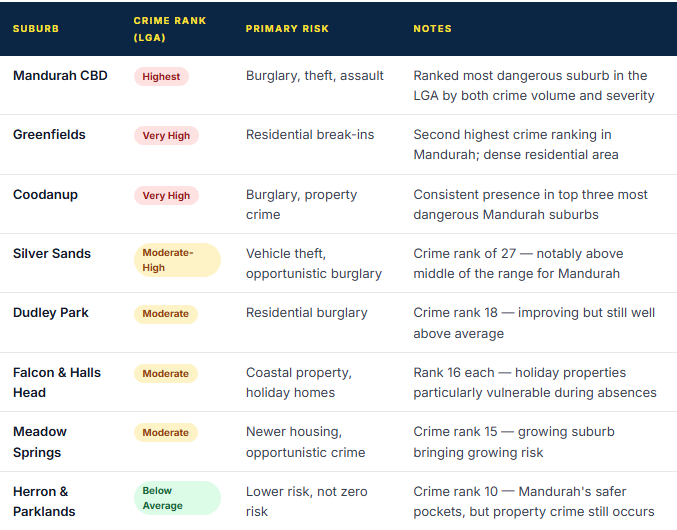
Even in Mandurah’s quieter suburbs, no property is immune. The research on how burglars select targets is consistent across multiple studies: they look for houses that are easy — unsecured access points, no visible alarm, no lighting, no signs of occupancy. The suburb you’re in changes the likelihood of being targeted. The visible security measures on your property change whether you’re actually selected when someone’s in your street looking for a target.
The Real Difference Between Alarm System Types
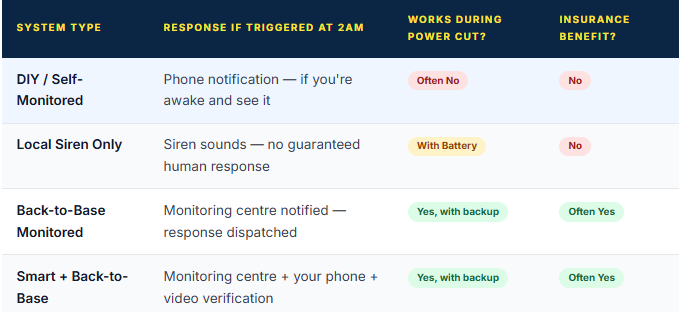
Walk into any conversation about security alarms and you’ll hear a lot of terms thrown around — wireless, smart, monitored, self-monitored, Grade A1, GPRS. It can be overwhelming. But the practical differences come down to one key question: if someone breaks into your property at 2am on a Tuesday when you’re fast asleep, what actually happens?
DIY and Self-Monitored Systems
The appeal of these is obvious: lower upfront cost, no ongoing monitoring fees, quick to set up. You get a notification on your phone when something triggers. What you don’t get is any guarantee that anything happens as a result of that notification. If your phone is on silent, you’re travelling, or you’re simply not in a position to respond — nothing happens. The alarm might sound. The burglar might even leave. Or they might take their time.
For a holiday property in Falcon that sits empty for weeks at a time, a self-monitored system is essentially a false sense of security dressed up in plastic housing.
Local Sirens — Better Than Nothing, Not Much Better
These trigger a loud siren when someone breaks in. The theory is sound: noise deters intruders and alerts neighbours. The reality in most residential streets — including in Mandurah — is that alarm fatigue has set in. People hear sirens and they don’t act. Nobody calls police because they assume it’s a false alarm. The burglar has learned this too.
A siren is a deterrent. It’s not a response.
Back-to-Base Monitored Alarms
This is what most security professionals recommend as a baseline — and it’s what Access 1 Security Systems installs as standard across Mandurah residential and commercial properties. When your alarm triggers, the signal goes directly to a 24/7 monitoring centre. Trained staff verify the activation, attempt to contact you, and if the situation isn’t resolved — police or a patrol response is dispatched.
The key word there is response. Something actually happens, independent of whether you’re awake, where you are, or whether you have signal on your phone.
A siren tells you someone broke in. A monitored alarm does something about it. Those are two very different things, and the gap between them matters most at the moment when something actually goes wrong.
— Andrew Herrmann, Founder, Access 1 Security Systems
Smart Systems With App Integration
Modern panels can combine back-to-base monitoring with app-based access, so you can arm and disarm remotely, receive real-time push alerts with video verification attached, and check your cameras from anywhere in the world. For Mandurah homeowners with properties in Dawesville, Falcon, or along the estuary — places that spend significant time unoccupied — this kind of remote visibility adds a meaningful layer of control on top of professional monitoring.
What Actually Makes a Security Alarm Installation Good or Bad
The honest truth is that the alarm panel itself is the least important part of the equation. What makes a security system effective — or not — is the installation decision-making that goes into it. Two properties can have the same hardware installed in completely different ways, and end up with completely different levels of real protection.
Here’s what separates a thorough installation from a rushed one:
- ✓A site walk before anything is quoted. A consultant who quotes you over the phone without seeing your property has no idea what they’re recommending. The entry points, blind spots, and specific risks of your home or business in Mandurah can only be understood on-site. If a company gives you a price without visiting first, treat that as a red flag.
- ✓Sensors at realistic entry points — not just the front door. Most residential break-ins in Mandurah come through rear access — back doors, sliding glass doors, side gates, garage entries. A system that only covers the front of a property has a blind side that anyone reasonably familiar with how break-ins work will know to use. Every realistic entry point needs detection.
- ✓Dual-path communication for the monitoring signal. A burglar who knows what they’re doing will cut your phone line before they enter. A monitoring connection that only runs via landline or single-path NBN is vulnerable to this. Dual-path systems — typically a combination of GPRS mobile and IP — mean that if one communication channel is disrupted, the signal still gets through via the other.
- ✓Coastal-grade outdoor hardware. Mandurah’s proximity to the ocean and estuary means salt air and humidity are real factors for any outdoor sensor or siren housing. Hardware rated for coastal conditions performs considerably better over time than standard residential gear. If your installer can’t tell you the IP rating or coastal certification of any outdoor components, ask specifically.
- ✓Battery backup on the main panel. Power outages happen — particularly during summer storms in coastal WA. Your alarm panel should maintain operation for a minimum of four hours on battery backup. This is easy to overlook in an initial quote, but essential for continuous protection.
- ✓Testing every single zone before the installer leaves. Every sensor, every communication path, every zone should be triggered and verified before the handover. A technician who skips or rushes the testing phase is skipping the one step that confirms whether what they’ve installed actually works.
Security Alarms for Mandurah Homes — Specific Considerations
Residential security in Mandurah has a few particular wrinkles that are worth understanding when you’re designing a system.
Holiday and semi-holiday properties along the Mandurah coastline — Falcon, Dawesville, Halls Head, and around the estuary — are a specific category. These homes can sit unoccupied for extended periods, which makes them attractive targets and also means any alarm system needs to function reliably without anyone on-site. Back-to-base monitoring is non-negotiable for these properties. Smart app access that lets you check camera feeds and verify activations remotely is particularly valuable.
Newer suburbs like Meadow Springs and Lakelands are seeing growth in opportunistic crime as the population increases. Newer homes in these areas often come with builder-fitted alarm systems — usually the bare minimum — that leave meaningful gaps in coverage. If you’ve moved into a newer Mandurah property and the alarm was part of the build, it’s worth having a licensed security consultant assess whether it actually covers what it should.
A lot of Mandurah homeowners assume the alarm system included in their builder package is adequate. Builder alarm packages are almost always designed around the cheapest quote that satisfies a basic specification. They commonly have too few sensors, miss key secondary entry points, and don’t include monitoring as standard. It’s worth a free assessment before assuming you’re covered.
Security Alarms for Mandurah Businesses — It’s a Different Conversation
Commercial security in Mandurah requires thinking about risks that simply don’t apply to a house. Multiple staff members with different access schedules, high-value stock, point-of-sale equipment, and insurance policy requirements all change what an adequate system looks like.
The businesses Access 1 encounters most frequently with inadequate systems tend to fall into predictable categories:
- Retail businesses on the Mandurah waterfront and in the City Centre.Single-zone alarm systems are common here — they treat the entire premises as one detection area, which creates practical problems around opening and closing procedures and means a triggered alarm anywhere in the building trips the whole system. Multi-zone systems allow individual areas to be armed and disarmed independently, which is far more workable for businesses with staggered hours or different areas with different access needs.
- Hospitality venues near the estuary and foreshore.High-value equipment, accessible stock, and POS systems make these businesses attractive after-hours targets. The combination of internal motion detection, perimeter sensors, and CCTV integration is typically the right baseline for these premises — particularly combined with monitoring that responds after hours when staff are gone.
- Trade and industrial businesses in Mandurah’s industrial areas.Tools, machinery, and vehicles parked overnight are commonly targeted. External beam sensors covering large yard areas and driveways, paired with floodlight-integrated cameras, often provide better coverage here than internal sensors alone. The detection perimeter needs to extend beyond the building footprint.
- Offices and professional services businesses.These properties often overlook security because the risk doesn’t feel immediate. But computers, data, and client files represent significant loss if accessed. Access control combined with an alarm system — so you have a record of who entered and when — is standard for any professional services business in Mandurah taking their obligations around client data seriously.
The Monitoring Question — What Grade A1 Means and Why It Matters
Not all monitoring centres are equal. In Australia, monitoring centres are graded by certification bodies, with Grade A1 being the highest available. It reflects the centre’s physical security, response capability, power redundancy, staffing standards, and operational protocols.
Access 1 Security Systems uses a Grade A1 monitoring centre for all monitored installations. When you’re comparing security providers in Mandurah, asking about the monitoring grade is a straightforward way to separate the serious operators from the rest. Some companies are deliberately vague about this — which itself tells you something.
The monitoring connection matters just as much as the monitoring centre. The three main options are:
- 1 GPRS single SIM. Mobile network connection. Works without an internet connection or landline. NBN-compatible. Single path, but more reliable than IP-only in most Mandurah conditions.
- 2 GPRS dual SIM. Two independent mobile network connections. If one carrier experiences an outage or the SIM is somehow disabled, the backup path keeps the signal going. This is the option Access 1 recommends for most Mandurah residential and commercial properties.
- 3 IP module with app access. Internet-based monitoring with smartphone access for self-monitoring or hybrid monitoring. Best combined with a GPRS backup path — not recommended as the sole communication method given the vulnerability to internet outages and router interference.
Should You Add CCTV to Your Alarm System?
For most Mandurah properties — yes. The two systems do fundamentally different things, and combining them gives you something neither can deliver alone.
An alarm system detects a breach and triggers a response. CCTV records what happened and deters intrusion at the perimeter before anyone reaches a door or window. Together, they also enable video verification — when your alarm triggers, your monitoring centre can immediately pull camera footage to confirm whether the activation is a real intrusion before dispatching a response. This matters for two reasons: it reduces the cost and inconvenience of false alarm call-outs, and it means a genuine intrusion gets a faster, higher-priority response.
For Mandurah businesses, CCTV is essentially non-negotiable at this point. The WA Police data shows that 83% of solved burglaries in Perth involved CCTV footage as primary evidence. If something does happen to your property, having footage is the difference between a police investigation with something to work with and a report that goes nowhere.
How to Assess Any Security Company Operating in Mandurah
The security installation industry in WA has some excellent operators and some who are cutting corners. Here’s a simple framework for evaluating anyone you’re considering.
- ✓Check their licence. Security installation is a licensed activity in Western Australia under the Security and Related Activities (Control) Act 1996. Ask for the company’s licence number and verify it through the WA Department of Mines, Industry Regulation and Safety. A reputable company will provide this without hesitation.
- ✓Insist on a site visit before any quote. As mentioned earlier — you cannot accurately quote a security system without seeing the property. Any quote issued without a site inspection is a package, not a system designed for your actual risk profile.
- ✓Ask specifically about the monitoring grade. “Grade A1” is a concrete, verifiable certification. If the answer is vague — “we use a quality monitoring centre” — ask again and get a direct answer. Grade matters, and companies that use Grade A1 centres are proud of it.
- ✓Understand whether you own the equipment. Some security companies lease equipment, which means you’re paying indefinitely for hardware you never own and face steep exit costs if you want to change providers. Always clarify ownership. With Access 1, you own the equipment outright from day one — no lease, no lock-in.
- ✓Ask about the brands and products they install. Commercial-grade equipment — Bosch, Hikvision, and comparable brands — behaves meaningfully differently from consumer-grade hardware in terms of reliability and lifespan. If a company is cagey about what they’re actually installing, that’s worth noting.
- ✓Look at the detail in their reviews. Reviews that name the installer, describe the installation process, and mention after-sales follow-up are indicators of a company that does consistent work. Generic five-star ratings with no detail tell you much less.
Access 1 Security Systems was founded in 2003 by Andrew Herrmann, who came to the business through years working in WA’s security industry — including time as a control room operator, security consultant, and across multiple other licensed security roles. The company has grown into one of Western Australia’s most well-regarded independent security providers, with clients ranging from individual homeowners to national franchise networks.
The Access 1 approach is straightforward: a proper site assessment first, a system recommendation that’s actually appropriate for your property and risk profile, commercial-grade installation by licensed technicians, and Grade A1 back-to-base monitoring. No lease arrangements. No lock-in contracts designed to trap you. The equipment you pay for is yours.
The company services Mandurah and surrounding areas including Halls Head, Falcon, Dawesville, Greenfields, Meadow Springs, Lakelands, Dudley Park, and the broader Peel region.
Andrew founded Access 1 Security Systems in 2003 after working across multiple roles in the WA security industry, including control room operations, security consulting, event security management, and private investigations. His licences span electronics, security manpower, private investigations, and security consulting. Access 1 has operated in Perth and surrounding regions including Mandurah for over 20 years and has built its reputation on straightforward advice, quality installations, and a commitment to clients that goes well beyond the initial install.